Reading material for Lesson 2.3 Laws of Learning and Theories of Learning
4. Theories of learning
4.1. Classical conditioning theory
Classical conditioning theory
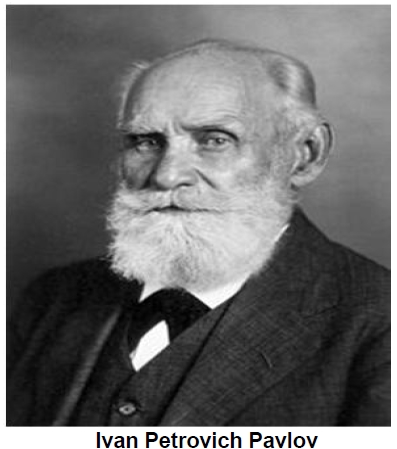 | PAVLOV - Ivan Petrovich Pavlov (September 1849 - February 1936) Famous Russian physiologist. Nobel Prize in Physiology or Medicine 1904. Pavlov studied physiology at Leipzig University in Germany for five years. |
|---|
Pavlov's theory of classical conditioning states that stimulus and response are inter-related while learning process takes place. Pavlov made this theory more clearly by conducting an experiment with a 'dog' as shown in Fig 1. He cut holes in dogs' cheeks and inserted tubes to measure salivation.
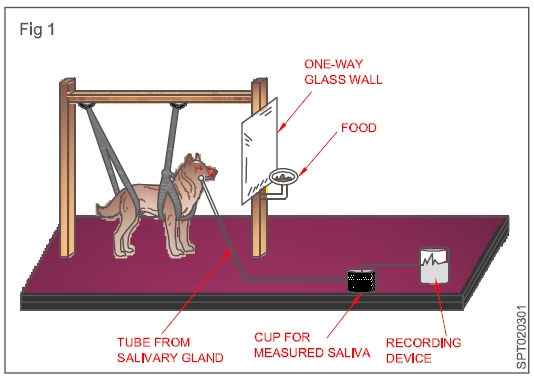
A bell was rung just before food was given to the dog, and after a period of time it was observed that the ringing of the bell alone would increase the rate of the dog’s salivation.
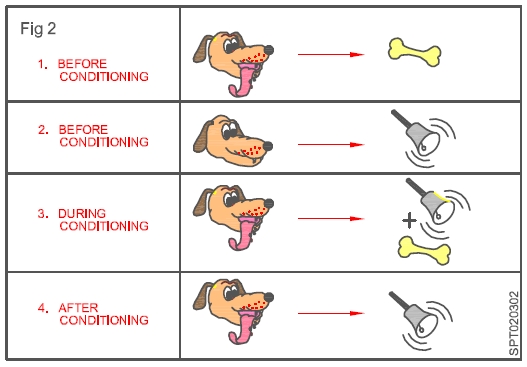
A dog was given food at fixed repeated intervals. A bell was being rung then food was served. This was repeated for many days. One day the bell rang but no food was served. The dog was anticipating for arrival of the food after hearing the ring. It started dripping the saliva. For the dog ringing of the bell was conditioned stimulus and the response of secretion and dripping of the saliva was an unconditioned response. Salivation, Pavlov noted, is a reflexive process. It occurs automatically in response to a specific stimulus and is not under conscious control. The more the stimulus the more the responses shown in Fig 2.
Benefits:
Pavlov's discovery of classical conditioning remains one of the most important in psychology's history, the conditioning process remains important today for numerous applications, including behavioural modification. Classical conditioning is often used to treat phobias, anxiety and panic disorders also.