Reading material for Lesson 2.3 Laws of Learning and Theories of Learning
4. Theories of learning
4.2. Trial and Error theory
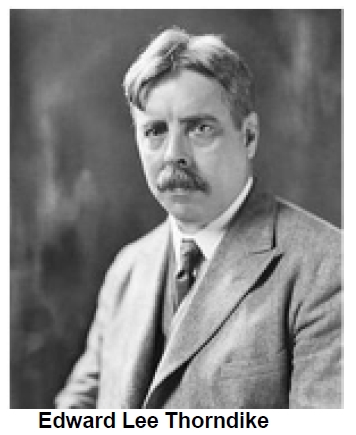 |
Edward Lee Thorndike (August 1874 - August 1949) American psychologist |
|---|
Thorndike - an American psychologist, his work on animal behaviour and the learning process led to the theory of connectionism (a set of approaches in the fields of artificial intelligence and cognitive psychology, helped to lay the scientific foundation for modern educational psychology). He also worked on solving industrial problems, such as employee exams and testing. He has been considered as father of modern educational psychology in US.
In his theory the learners set a goal and he tries to achieve it after making several trails. This theory is known as Thorndike theory or Trial and Error. He placed a cat in a cage (Fig 3) and a plate of fish outside the cage. The door arrangement of the cage was such a way that- by stepping on the slot the door opens. The cat tried several time to step on the slot but was not succeeded. Accidentally in one of its attempts stepped on the slot and the door was opened, cat ate the fish. In a similar occasion the cat opened the door easily by stepping on the slot. Similarly we can also learn through trial and error methods.
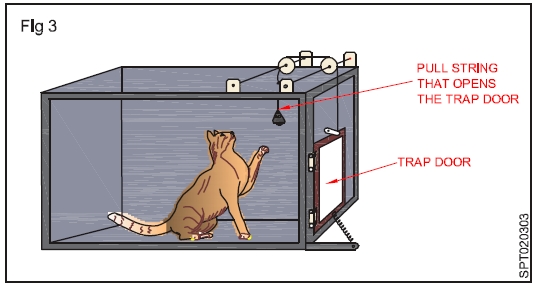
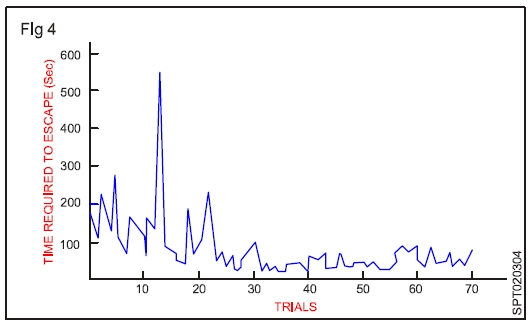
Thorndike looked at how Cats learned to escape from puzzle boxes. His finding was that cats consistently showed gradual learning as shown in Fig 4.
Experiment outcome:
• Thorndike's instruments learning curves revealed by plotting the time it took, for an animal to escape the box each time it was in the box.
• If the animals were showing insight, then their time to escape would suddenly drop to a negligible period.
• So it was trial-and-error
• These led Thorndike to formulate first his Principles of Learning and then his Theory of Learning that became the foundation of modern educational psychology.