Reading material for Lesson 2.3 Laws of Learning and Theories of Learning
4. Theories of learning
4.4. Operant conditioning theory
B.F Skinner (Mar 1904-Aug 1990)

An Americal
psychologist behaviourist, he was the Edgar Pierce
Professor of Psychology at Harvard University.
Skinner (1948) is regarded as
the father
of operant
conditioning, but his work has based on Thorndike (1898)
Law of effect.
Skinner introduced a new term Reinforcement.
That is, behaviour which is reinforced
tends to be repeated (i.e., strengthened); behaviour which
is not reinforced tends to die-out or be extinguished. (i.e. weakened).
Skinner studied
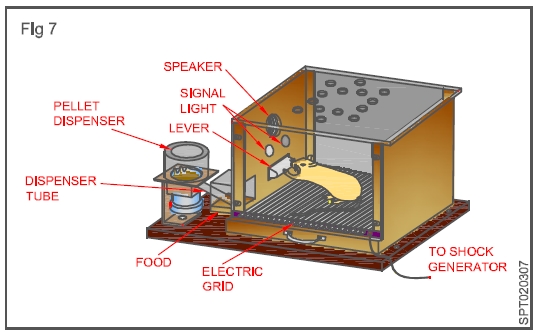
operant conditioning by conducting experiment using rats which he placed in a ‘Skinner
box’ similar to Thorndike’s puzzle box as shown in Fig 7
Skinner identified three types of responses or operants that can follow behaviour
• Neutral operants
• Reinforcers
• Punishers
Positive reinforcement Skinner showed how positive reinforcement worked
by placing a hungry rat in the above box. The box contained
a lever on the side and as the rat moved about
the box, it would accidentally knock the lever. Immediately it did so a food pellet
would drop into a container next to the lever.
The rat quickly learned to go straight
to the lever after a
few times of being put in the box.
The consequence of receiving food if they pressed the lever ensured
that they would repeat
the action
again and again. Positive reinforcement strengthens a
behaviour by providing a consequence an individal
finds rewarding.
Negative reinforcement Negative reinforcement strengthens behaviour because it stops or removes an unpleasant experience.
The removal of an unpleasant reinforcer can also strengthen
behaviour. In fact Skinner
even taught the
rate by
subjecting them in the box with an unpleasant electric current which
caused it some discomfort. The rats soon
learnt to press the lever when the light came on because they know that this would stop the electric
current being switched ON. Punishment Punishment is defined as the opposite
of reinforcement since it is
designed to weaken or eliminate a response rather
than increase it. It is
an aversive
event that decreases the behaviour that follows. Punished behaviour
creates fear and does not necessarily
guide towards desired behaviour - reinforcement tells you what to do, punishment only tells you what not to do.