Reading material for Lesson 2.3 Laws of Learning and Theories of Learning
4. Theories of learning
4.5. Theory of Imitation
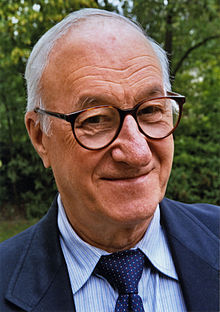
Albert Bondura
Canadian - Americal psychologist
Albert Bondura - Canadian - Americal psychologist, professor at Standfort University - His social learning theroy poists that people learn from one another, via observation, imitation and modeling. The theory has often been called a bridge between behaviourist and cognitive learning theories because it encompasses the attention, memory and motivation.
Theory
We all try to imitate. Children try to imitate action of their elders. Imitation is learnt from school, institute, home and outside environment. Imitation is considered to be one of the natural qualities of human being. From elders/adults imitate like their precedents. Imitation is very useful in attaining skill. The imitation can be effected consciously or unconsciously. Sometime, complex and tough actions either new or difficult to imitate also reduces this specific skill. Imitation helps backward learners. It has some disadvantages some times bad qualities are also learnt through imitation. It is the responsibility of the instructor to guide the learner properly to avoid imitating wrong methods and means instrument or agency to learn a skill or attitude. Many teachers and parents today realize the importance of modelling acceptable behaviour.
In addition to the above theories of learning the following aspects are also to be considered by the instructor.
Senses are avenues of Learning
Human have five basic senses. These sensing organs associated with each sense and information to begin to help us understand and preceive the world around us.
Sensory learning is concerned with perception and sense. Sense organs are generally called the “Gates of knowledge”. A particular type of knowledge is acquired through a particular sense organ. With the associations and reaction to the environment, sense organs grow conscious. They are:
• Sense of sight (Visual sensation) is through eyes.
Colour, similarity, dissimilarity, reading and for all visual stimuli we use with eyes.
• Sense of hearing (Auditory
sensation) is through ears. Sounds of
different
nature - teacher’s talk, discussions, sounds made by machines and materials
or any other voice or sound reaches the ears as a stimuli eliciting responses.
• Sense of small (Factory sensation) is through the nose. We can identify different oils, burning of rubber insulation or a coil immediately through the smell, as and when proper response occurs.
• Sense of taste (Gustatory sensation) is through tongue. We use the tongue to know taste and through the taste we find difference between sweet, salt, tea, coffee, cheese, butter etc. In the food processing or catering field, this sense is much in use.
• Sense of touch (Tactual sensation) is through links or parts of body. Touching enables one to find out smoothness, softness, hardness and roughness of different degrees. By proper utilization of this sensation even blind men develop strong stimuli to other responses involving other organs.
Kin aesthesis (Muscular sense). We perceive through muscular feel when pressing, pulling, pushing, holding, balancing etc.
All the six senses play important part in acquisition of motor skills and knowledge and they are known as avenues of learning. A good instructor exploits as many senses as possible and each of the sense responds only to its own type of stimuli.
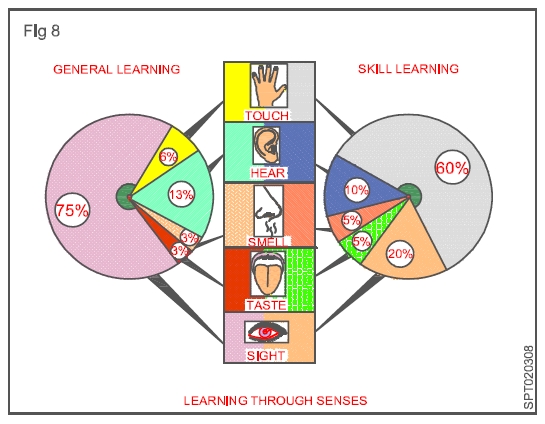
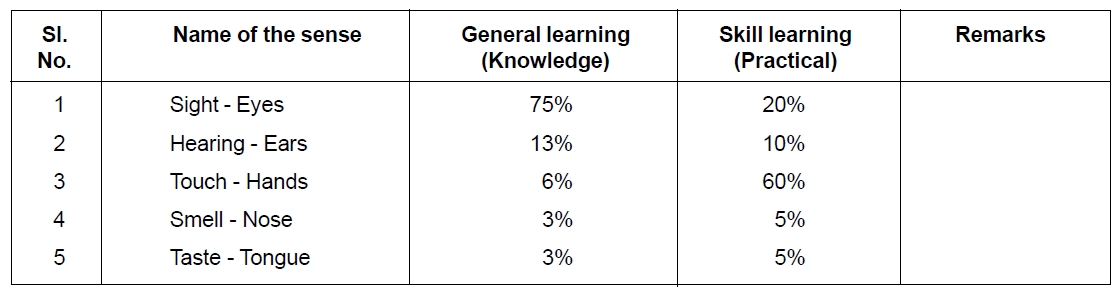
A comparative statement of various sense organs and their effectiveness under general learning (knowledge) situation and Skill learning (practical) situation are graphically shown in Fig 8 and the same is given in the Table.
Individual Differences
All the trainers/learners do not have alike, the difference may be physical, mental and psychological.
• Physiological differences: Fatness, leaness, darkness, fairness, tallness, shortness of stature are various physical differences. Some of these have adverse effect on the motor learning.
• Mental differences: Intelligence, foolishness, mental backwardness is due to the traits of people, differs from one another.
• Phychological differences: Some are liberal while others are not. Some have certain special traits to learn certain subject or doing certain jobs. Some learn quickly while others slowly.Causes of individual differences • Heredity: Genes are responsible
for individual differences. Parents
play an
important role
in the
individual differences. • Environment: Environment has various features
- Physical and social.
Social environment play a more important part in creating
individual differences. • Age: Age
is another factor to be reckoned in this. Physical psychological and emotional development is caused by the growth in age. • Intelligence: Some have higher I.Q. Some are mentally
backward and retarded
while some are exceptionally intelligent. • Economic condition: Economic condition of parents
does cause individual differences. The instructor must take into account these differences
and
pay special attention
to those who require the specific
technique to bridge the gap.